What Does Pompeii Look Like Today? Now vs Then
What Does Pompeii Look Like Today?
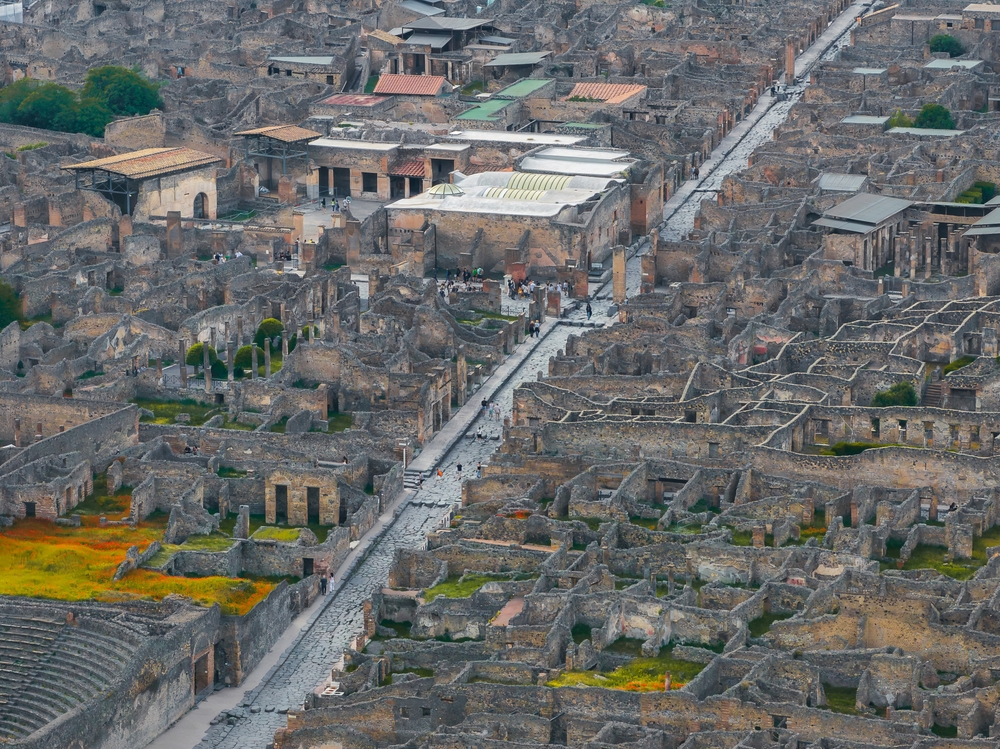
Today, Pompeii is a vast open-air archaeological park — the excavated ruins of the Roman city, with roofless houses, paved streets, temples, baths, theatres, and the amphitheatre all standing partly restored, alongside frescoes, mosaics, and plaster casts of victims. About two-thirds of the ancient city has been uncovered, and excavation and conservation are still ongoing. Right next to these ruins sits a living modern town of about 25,000 people, also called Pompei. So Pompeii both is and isn't still a "city."
This page clears up the common confusion between the ancient ruins and the modern town, and compares Pompeii now versus then. For galleries of the site, see pictures of Pompeii today; to navigate it, see the map of Pompeii.
The Ancient City: An Archaeological Park
The Pompeii most people mean is the Parco Archeologico di Pompei, the protected ruins of the town destroyed in 79 AD. You walk the original Roman streets, step into real houses, and see the plaster casts of those who died. It is not a reconstruction or a theme park; it is the genuine, fragile fabric of a Roman town, kept standing by constant conservation work. New discoveries still emerge regularly from the unexcavated third of the site, such as fresh frescoes and bakeries uncovered in recent years.
Practical basics: a standard adult ticket is required, hours are typically 09:00–19:00 (Apr–Oct) and 09:00–17:00 (Nov–Mar) with last entry about 90 minutes before close, and you should plan three to five hours. Always confirm current prices and opening times on the official site, pompeiisites.org.
The Modern Town: Pompei (One "i")
Confusingly, there is also a modern town of Pompei, which grew up beside the ruins in the 19th and 20th centuries. It is a normal, functioning Italian town of roughly 25,000 residents, with apartment blocks, restaurants, a railway station, and — its biggest landmark — the Pontifical Shrine of Our Lady of the Rosary, a major Catholic pilgrimage church. In Italian the modern town is spelled Pompei, while the ancient site is usually written Pompeii in English. Many visitors arrive expecting only ruins and are surprised to find a busy living town right outside the gates.
Now vs Then: A Comparison
| Aspect | Then (79 AD) | Now (today) |
|---|---|---|
| Status | Living Roman port city | Archaeological park + neighboring modern town |
| Population | ~11,000–15,000 residents | Ruins: none living. Modern Pompei: ~25,000 |
| Coastline | Near the sea, with a river port | Ruins now ~2 km inland |
| Buildings | Roofed, painted, fully furnished | Roofless ruins, partly excavated and conserved |
| Centerpiece | The Forum and its temples | Excavated Forum, casts, museums; modern shrine nearby |
| Vesuvius | Active, unrecognized as a volcano | Still active and closely monitored |
So, Does Pompeii Still Exist?
Yes — and it is more accurate to say two Pompeiis exist side by side: the silent ancient ruins inside the park, and the living modern town of Pompei next door. The ancient city is no longer inhabited, frozen as it was in 79 AD, while the modern town carries on ordinary life. Understanding that distinction is the single most useful thing to know before you visit. To plan a trip into the ruins themselves, see our guide to the archaeological park, and browse photos of Pompeii today to see exactly what you'll find.
Related Pages
- Pictures of Pompeii Today — Photo galleries of the modern ruins
- Map of Pompeii — The site plan and how to get around
- Pompeii Today — Overview of the site in the present day
- The Archaeological Park — Visiting the excavated city
Skip-the-Line Ticket with Audio Guide
Planning a visit today? Book an instant mobile ticket with self-guided audio tour and map.
Frequently Asked Questions
What does Pompeii look like today?
Today Pompeii is a large open-air archaeological park: streets, houses, temples, baths, theatres, and the amphitheatre stand partly excavated and roofless, with frescoes, mosaics, and plaster casts of victims on display. Roughly two-thirds of the ancient city has been uncovered, and conservation and new digs continue. Right beside the ruins is the modern town of Pompei.
Does Pompeii still exist?
Yes — in two senses. The ancient Roman city still exists as preserved ruins inside the Pompeii Archaeological Park, one of the world's most visited heritage sites. Separately, a modern town called Pompei (with one 'i' in Italian) exists right next to it, home to about 25,000 people and the Pontifical Shrine. They are different places that share a name.
Is Pompeii still a city?
The ancient Pompeii is not a living city — it is an archaeological park of ruins, abandoned since 79 AD. But the modern town of Pompei beside it is very much a functioning city of around 25,000 residents, with shops, churches, a railway station, and the famous Sanctuary of Our Lady of the Rosary. Visitors often confuse the two.
Can you walk through Pompeii today?
Yes. Visitors walk the original Roman streets on foot, entering excavated houses, the Forum, baths, theatres, and the amphitheatre. A standard adult ticket is required, and the park is typically open 09:00–19:00 in summer and 09:00–17:00 in winter; always confirm current hours and prices on the official site, pompeiisites.org. Allow three to five hours.