Pompeii City Volcano — Vesuvius and the Destruction
The Volcano That Destroyed a City
Pompeii is often called a pompeii volcanic city — a place whose identity is forever bound to the eruption that ended it. The story of this pompeii city volcano relationship is inseparable from the story of Mount Vesuvius, the volcano that both nurtured and destroyed the ancient city. Vesuvius provided the fertile soil that made the region prosperous and the eruption that buried Pompeii under meters of volcanic material, preserving it for posterity as an unparalleled archaeological treasure.
Vesuvius: A Geological Profile
Mount Vesuvius (Italian: Vesuvio) is a somma-stratovolcano, meaning it consists of an older outer summit (Monte Somma) partially surrounding a younger cone (Vesuvius proper). The volcano stands 1,281 meters (4,203 feet) above sea level and is located approximately 9 kilometers east of Naples, making it arguably the most dangerous volcano in the world due to the density of population in its immediate vicinity.
Vesuvius is part of the Campanian volcanic arc, which formed at the convergence of the African and Eurasian tectonic plates. The subduction of the African plate beneath the Eurasian plate creates the magma that feeds Vesuvius and other volcanoes in the region, including Campi Flegrei (Phlegraean Fields) and the volcanic island of Ischia.
Understanding the pompeii city and vesuvius volcano dynamic is essential: the fertile volcanic soils made the region prosperous, while the ever-present threat of eruption loomed unrecognized for centuries.
Before the Eruption
In the decades before 79 AD, there were warning signs that Vesuvius was not the dormant hill that Pompeians believed it to be. In 62 AD, a severe earthquake struck the region, causing significant damage to Pompeii and neighboring cities. This earthquake is now understood to have been related to the magmatic activity building beneath Vesuvius.
The Romans of this era did not recognize Vesuvius as a volcano. The mountain was covered in vineyards and forests, and its last known eruption had occurred roughly 1,800 years earlier (the Avellino eruption, circa 1800 BC). The Greek geographer Strabo was one of the few ancient writers to note that the area showed signs of volcanic activity, observing the fire-scorched appearance of the rocks at the summit.
The Eruption Mechanism
The eruption of 79 AD was what modern volcanologists classify as a Plinian eruption, characterized by a towering column of gas, pumice, and ash ejected high into the atmosphere. The eruption column reached an estimated height of 33 kilometers (20 miles), penetrating the stratosphere.
The eruption progressed through two main phases:
Phase 1: The Plinian Column (approximately 1:00 PM, August 24 to midnight)
The initial explosion sent a massive column of pumice and ash into the sky. Prevailing winds carried this material southeast, directly over Pompeii. Pumice stones and ash rained down on the city at rates estimated at 15-20 centimeters per hour. By evening, approximately 2.8 meters (9 feet) of material had accumulated on rooftops and streets. This phase was terrifying but survivable for those who could shelter or flee.
Phase 2: Pyroclastic Surges (approximately 1:00 AM to 8:00 AM, August 25)
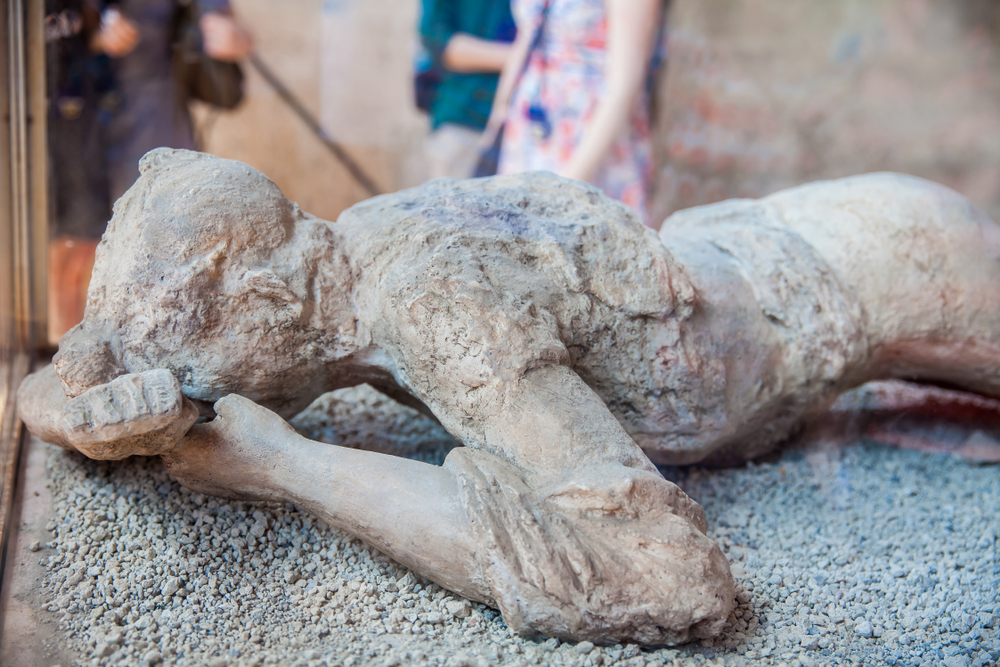
As the eruption column became unstable and collapsed, it generated a series of pyroclastic density currents — superheated mixtures of gas and volcanic fragments that flowed down the slopes of Vesuvius at speeds up to 700 km/h and temperatures between 300 and 700°C. Six main surges occurred, progressively reaching further from the volcano. The fourth surge was the first to reach Pompeii, killing everyone who remained in the city.
A common misconception portrays pompeii city on fire during the eruption, but the city was not consumed by flames. Instead, it was buried under waves of superheated gas and volcanic debris — pyroclastic surges — which killed instantly through heat and asphyxiation rather than combustion.
The Continuing Threat
Mount Vesuvius has erupted dozens of times since 79 AD, with its most recent eruption occurring in March 1944. Today, approximately 3 million people live in the greater Naples metropolitan area, with roughly 600,000 residing in the highest-risk "red zone" on the volcano's slopes.
The Italian government maintains a detailed emergency plan for a potential eruption, which includes the evacuation of the red zone population. The Osservatorio Vesuviano, founded in 1841 and the world's oldest volcanological observatory, continuously monitors the volcano using seismic sensors, GPS stations, gas measurements, and other instruments.
The question is not whether Vesuvius will erupt again, but when. Understanding the volcano that created Pompeii is essential to appreciating both the archaeological site and the ongoing geological drama of the Campanian region.
Pompeii VIP Tour — Reserve Your Date
Pair the ruins with the volcano that buried them — reserve a premium guided experience.
Frequently Asked Questions
What volcano destroyed Pompeii?
Mount Vesuvius (Vesuvio in Italian) destroyed Pompeii in 79 AD. It is a stratovolcano located on the west coast of Italy, about 9 km east of Naples and 8 km northwest of Pompeii. It is the only active volcano on the European mainland.
Is Vesuvius still active?
Yes, Mount Vesuvius is classified as an active volcano. Its last eruption occurred in March 1944 during World War II. While it is currently in a quiescent phase, volcanologists consider another eruption inevitable and it is one of the most closely monitored volcanoes in the world.
Could Vesuvius erupt again like it did in 79 AD?
While a Plinian-scale eruption like 79 AD is considered unlikely in the near term, it is not impossible. The longer the repose period, the more energy can potentially build up. Italian authorities maintain emergency evacuation plans for the roughly 600,000 people living in the highest-risk 'red zone' around the volcano.