The Last Day of Pompeii: An Hour-by-Hour Account
A City That Did Not Know It Was Living Its Final Day
The last day of Pompeii began like any other. Bakers fired their ovens, shopkeepers raised their shutters, and the morning crowds drifted toward the Forum beneath a clear sky. No one in the prosperous Roman town imagined that within twenty-four hours their city would vanish beneath meters of volcanic debris, sealed away for nearly seventeen centuries. The story of the final day of Pompeii survives in extraordinary detail thanks to a teenage eyewitness, the bodies frozen in their last moments, and more than two centuries of archaeology.
What follows is an hour-by-hour reconstruction of Pompeii's last day in 79 AD, drawing on the letters of Pliny the Younger, the layered geology preserved at the site, and modern volcanological study. It is a dramatic account — but every hour rests on evidence rather than imagination. For the broader scientific picture, see our companion page on the eruption of 79 AD.
The Morning Before: Signs That Were Ignored
For days, perhaps weeks, Vesuvius had been giving warnings that no one knew how to read. Small earthquakes had been rattling the region with growing frequency, but earthquakes were nothing unusual along the Bay of Naples — the city was still rebuilding from a major quake in 62 AD that had toppled temples and homes. Springs and wells ran dry as rising magma heated the groundwater. The Roman writer Cassius Dio later claimed that strange giant figures were seen wandering the slopes, possibly the product of volcanic gases and frightened imaginations.
To the people living through Pompeii's last day, none of this signaled catastrophe. Vesuvius was not even recognized as an active volcano. Its slopes were green with vineyards, and no eruption lived in human memory. The mountain that loomed over the city was simply part of the landscape — fertile, familiar, and, as far as anyone knew, harmless. Life on the morning of the final day of Pompeii continued in complete normalcy.
Around 1:00 PM: The Column Bursts the Sky
The calm shattered in the early afternoon. With a roar that likely carried across the entire Bay of Naples, Vesuvius blew open its summit. A column of gas, pumice, and ash erupted upward at tremendous velocity, punching through the clouds and rising to an estimated height of around 30 kilometers, into the stratosphere itself.
Across the bay at Misenum, roughly 30 kilometers away, a seventeen-year-old named Pliny the Younger was staying with his uncle, the naturalist and fleet commander Pliny the Elder. His mother drew their attention to a bizarre cloud rising over the mountains. Pliny the Younger later described it, in his famous letters to the historian Tacitus, as resembling a Mediterranean umbrella pine — a tall trunk spreading into branches at the top. The description was so precise that volcanologists today call this kind of event a Plinian eruption in his honor. It is the single most important written account of the last day of Pompeii, recorded by a survivor who watched from a safe distance.
At Pompeii itself, only about 8 kilometers downwind of the crater, the afternoon sky turned black. The first pale pumice stones began to patter down on rooftops and streets — at first small and almost curious, then steadily heavier.
Afternoon and Evening: The Plinian Phase
This was the long, grinding Plinian phase of the disaster, and it would last most of the day and into the night. Pumice and lapilli — light, frothy volcanic stones — fell at an estimated rate of 15 centimeters or more per hour. Within hours the streets were buried, and the weight on the rooftops became deadly. Beams groaned and snapped. Roofs began to collapse, killing and trapping people who had taken shelter inside their homes hoping to wait out the storm.
Faced with this, the residents made the choices that would decide who lived and who died. Thousands fled. They tied pillows over their heads against the falling stones and streamed out through the city gates into the darkened countryside, carrying what valuables they could. This long escape window is the reason most of Pompeii survived: the majority of the city's roughly 11,000 inhabitants got out during these hours. Others, however, chose to stay — sheltering in the strongest rooms, sealing doors against the ash, waiting for an end that would not come in time.
Across the bay, Pliny the Elder made a fateful decision of his own. Receiving desperate messages from people trapped along the coast beneath the volcano, he ordered the warships of the fleet launched and sailed directly toward the catastrophe — part rescue mission, part scientific curiosity. It was an act of remarkable courage that would cost him his life.
Nightfall: Darkness and Falling Stone
As night fell, the final day of Pompeii descended into a darkness more total than any natural night. The eruption cloud blotted out the moon and stars. By evening, well over a meter of pumice had piled up in the streets, and upper floors throughout the city were caving in. Fires flickered where overturned lamps caught on collapsing timber.
The pumice itself was changing. The early stones were white; later layers turned grey, a shift recorded in the geological deposits at Pompeii and reflecting the volcano tapping deeper, denser magma. Anyone still sheltering inside now faced an agonizing situation — rooms filling with ash, exits blocked by debris, and no way to know whether the worst had passed or was still to come.
Pliny the Elder, meanwhile, had reached the coast near Stabiae, about 4.5 kilometers south of Pompeii, unable to land where he intended because of the falling debris. He came ashore at the villa of his friend Pomponianus, and — whether from genuine calm or to steady his terrified hosts — bathed, dined, and went to sleep as the mountain raged.
The Early Hours: The Deadly Pyroclastic Surges
The truly lethal phase of the last day of Pompeii came not from the falling stone but from what happened when the towering eruption column could no longer hold itself up. After roughly eighteen hours, the column began to collapse. Instead of rising, the superheated mass of gas and volcanic debris poured back down the slopes of Vesuvius as pyroclastic surges — ground-hugging avalanches of incandescent gas and ash racing outward at speeds that could exceed 100 kilometers per hour.
A series of these surges swept down in the predawn hours. The first reached and annihilated Herculaneum on the western flank, killing everyone who remained, including the hundreds who had crowded into the shoreline boathouses hoping for rescue by sea. Then the surges turned on Pompeii. The first to overtop the city walls with full lethal force swept through the streets carrying temperatures estimated at 300 degrees Celsius or higher. Everyone still in the city — those hiding in their homes, those caught fleeing through the streets — died almost instantly from the thermal shock of the searing gas.
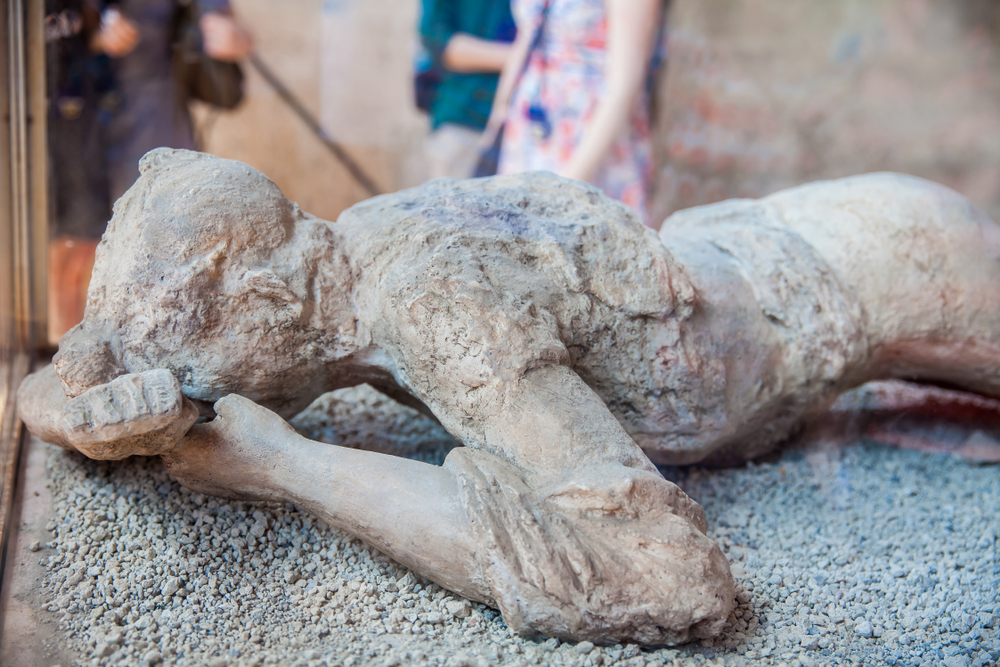
This is the moment captured by the famous plaster casts of Pompeii. The victims were buried where they fell, and as their bodies later decayed, they left hollow cavities in the hardened ash that archaeologists eventually filled with plaster, recovering their final postures — figures crouched, embracing, shielding their faces. To understand how these haunting forms were created and what they reveal, see our page on the bodies and plaster casts of Pompeii.
The Death of Pliny the Elder
At Stabiae, Pliny the Elder was woken as the eruption intensified and his courtyard filled with pumice, threatening to trap the household indoors. The group tied pillows to their heads and fled toward the beach through a darkness so complete that torches barely pierced it. There, on the shore, the elder Pliny collapsed. By his nephew's account he had long struggled with his breathing, and the thick, sulfurous air overwhelmed him. When his companions returned after the danger had passed, they found him dead — likely from suffocation or a heart attack brought on by the gas and ash. He was fifty-five, and he had sailed toward the disaster trying to help. His death is one of the most human episodes of the final day of Pompeii.
Midday After: A City Erased
By around midday on the day after it began, the eruption finally exhausted itself. Where Pompeii had stood for centuries, there was now a featureless grey plain, 4 to 6 meters deep. Not a single rooftop broke the surface. The neighboring towns of Herculaneum, Stabiae, and Oplontis had met the same fate. A city of 11,000 people had been wiped from the map in less than a day. The mountain responsible still dominates the region today, and you can read more about it on our Mount Vesuvius page.
At Misenum, Pliny the Younger and his mother survived the more distant effects — falling ash, a panicked crowd, a sea that briefly withdrew from the shore — and emerged into a world dimmed by floating ash. In the days that followed, some survivors crept back to dig tunnels into the hardened deposit, recovering valuables from buildings whose locations they still remembered. But within a generation the precise site of Pompeii was uncertain, and within a few centuries it was forgotten entirely.
The Date Controversy: August or Autumn?
For most of modern history, the last day of Pompeii was confidently dated to August 24, 79 AD — the date given in surviving copies of Pliny the Younger's letter. But that letter exists only in much later manuscript copies, and the date may have been garbled by centuries of recopying.
A growing body of evidence points instead to autumn. Archaeologists have found autumn fruits such as pomegranates and walnuts, grapes that had already been harvested, heating braziers set up as if against a chill, and victims wearing heavier clothing than an August heatwave would suggest. The decisive clue came in 2018, when excavators uncovered a charcoal inscription on a wall — a casual note scrawled by a workman — bearing a date corresponding to mid-October. Charcoal is fragile and fades within days, so the writing must have been made shortly before the eruption buried it. On this combined evidence, most scholars now favor an October or broader autumn 79 AD date for Pompeii's last day, though the traditional August date still appears in many older sources. The debate is explored further in our overview of the history of Pompeii.
Cultural Legacy: Bryullov's "The Last Day of Pompeii"
The drama of that day has echoed through art for centuries. The most celebrated example is Karl Bryullov's vast Romantic canvas "The Last Day of Pompeii" (1833), which depicts terrified citizens fleeing beneath a sky torn by lightning and collapsing statues. Painted after Bryullov visited the excavations, the work caused a sensation across Europe and helped fix the catastrophe in the popular imagination as a symbol of human fragility before nature. It is a reminder that the last day of Pompeii is not only an archaeological event but a story that has haunted the world ever since the ruins first re-emerged from the ash.
Related Pages
- The Eruption of 79 AD — The full hour-by-hour scientific account of the disaster
- History of Pompeii — From ancient origins to modern rediscovery
- The Bodies and Plaster Casts — How the victims of the final day were preserved
- Mount Vesuvius — The volcano behind the catastrophe
Pompeii: Small Group Tour with an Archaeologist
See it with an expert — a small-group walk through Pompeii led by a professional archaeologist.
Frequently Asked Questions
What date was the last day of Pompeii?
Traditionally the last day of Pompeii is dated to August 24, 79 AD, based on a manuscript copy of Pliny the Younger's letter. However, a charcoal inscription discovered in 2018 — reading a date equivalent to mid-October — together with autumn fruits, heating braziers, and warm clothing found at the site, has led most scholars to favor an October or autumn 79 AD date.
How long did the eruption that ended Pompeii last?
The eruption lasted roughly 18 to 24 hours. It began with the Plinian column around 1:00 PM and continued through the night, with the deadly pyroclastic surges that killed those remaining in Pompeii arriving in the early hours of the following morning, after about 18 hours of pumice fall.
Did anyone survive the last day of Pompeii?
Yes. The majority of Pompeii's estimated 11,000 residents fled during the long pumice-fall phase and survived. Roughly 2,000 people who stayed behind or were caught nearby were killed, most by the pyroclastic surges in the early morning. Pliny the Younger watched from across the bay at Misenum and survived to record it.
What killed the people of Pompeii?
Most victims who remained in Pompeii were killed almost instantly by the intense heat of the pyroclastic surges — fast-moving clouds of superheated gas and ash reaching 300 degrees Celsius or more. This thermal shock caused near-instantaneous death. Earlier deaths during the day came mainly from roof collapses under the weight of accumulating pumice.
Who recorded the last day of Pompeii?
Pliny the Younger, then about 17 years old, wrote the only surviving eyewitness account in two letters to the historian Tacitus decades later. He watched the eruption from Misenum, across the Bay of Naples, and described the death of his uncle, Pliny the Elder, who sailed toward the disaster and died at Stabiae.