Pompeii vs Herculaneum: Which Should You Visit?
Pompeii vs Herculaneum: The Short Answer
If you are weighing up pompeii vs herculaneum, here is the honest version before the detail: these are two very different experiences of the same disaster. Pompeii is enormous, dramatic, and world-famous — the place to feel the scale of a living Roman city frozen in 79 AD. Herculaneum is small, intimate, and astonishingly well preserved — the place to see the everyday textures of Roman life that almost never survive anywhere else.
So the question of herculaneum vs pompeii is really a question about you. Do you want grandeur and breadth, or detail and atmosphere? If your schedule allows, the genuine best answer is to visit both, because they complement each other so completely. But if you can only fit one in, this page will help you decide between pompeii or herculaneum with clear eyes.
Both towns died on the same day, buried by the same volcano, yet the difference between pompeii and herculaneum comes down to how each was buried — and that single fact shapes everything you experience as a visitor today.
At a Glance: A Side-by-Side Comparison
| Aspect | Pompeii | Herculaneum |
|---|---|---|
| Size | Vast — about 66 hectares | Compact core, a fraction of Pompeii's size |
| Time needed | 2-3 hours minimum, easily a full day | 1-2 hours |
| Crowds | Busy, often very crowded | Quieter, more relaxed |
| Burial | 4-6 m of ash and pumice | Up to 20 m of hot pyroclastic material |
| Preservation | Broad footprint, fewer upper floors | Wood, upper floors, furniture, food survive |
| Population (79 AD) | ~11,000 | ~4,000-5,000 |
| Signature sights | Forum, Amphitheatre, Villa of the Mysteries, Lupanar | Boat-house skeletons, wooden balconies, mosaics |
| Death evidence | Plaster body casts | ~300 skeletons in the boat sheds |
| Best for | Scale, grandeur, urban planning | Intimacy, preservation, calm |
| Access | Circumvesuviana — "Pompei Scavi" stop | Circumvesuviana — "Ercolano Scavi" stop |
Use this table as a quick reference, but the dimensions below are where the real decision lives.
Size and Time: Sprawl vs Intimacy
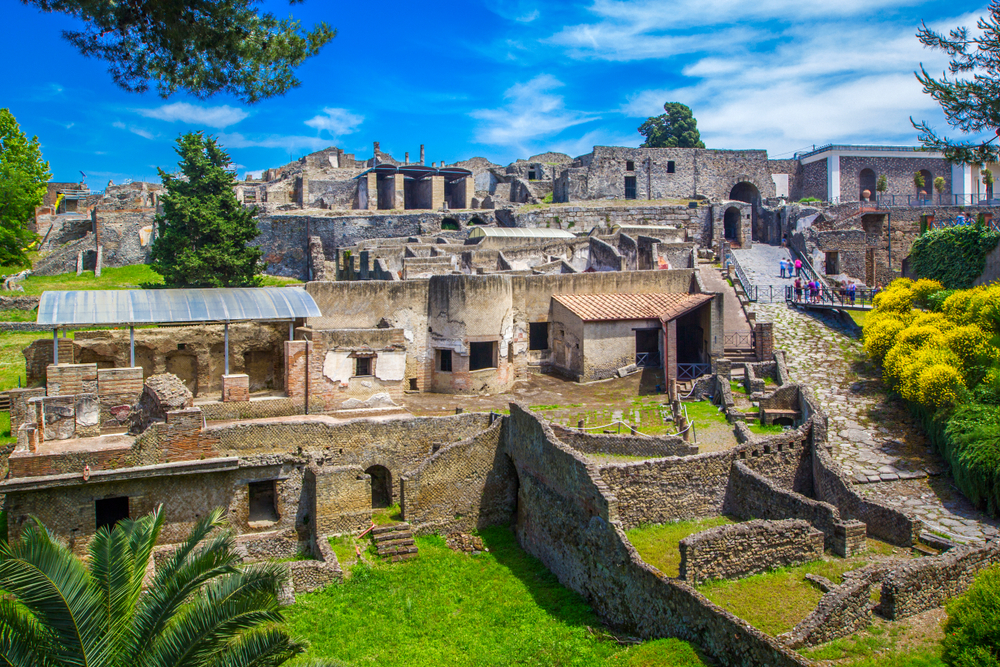
The most immediate difference between pompeii and herculaneum is sheer scale. Pompeii covers roughly 66 hectares, and even the excavated area is so large that you can walk for hours and still miss whole neighborhoods. A meaningful visit takes 2-3 hours at an absolute minimum, and serious enthusiasts happily spend a full day there. The reward is a sense of walking through a complete city — long stone-paved streets, a grand Forum, public baths, two theatres, and an amphitheatre that once held 20,000 spectators.
Herculaneum is the opposite. Its excavated core is compact and easily covered in 1-2 hours, and that is part of its charm. Instead of a route march, you get a dense, walkable grid of beautifully preserved houses, with the ancient shoreline and the dramatic excavation cut-away always close by. If you tire easily, are traveling with children, or simply prefer depth over distance, Herculaneum's manageable footprint is a genuine advantage.
For a practical breakdown of opening hours, tickets, and timing for the smaller site, see our dedicated guide to visiting Herculaneum. For the bigger picture on planning a Pompeii day, our visit guide and tickets page cover the essentials.
Crowds: Famous vs Peaceful
Fame has a cost. Pompeii is one of the most visited archaeological sites on earth, and in high season the main thoroughfares, the Forum, and the famous houses can be genuinely crowded. Early mornings and late afternoons help, but you should expect company.
Herculaneum, despite its quality, remains comparatively under the radar. You can often wander its streets and houses with only a handful of other visitors nearby. For travelers who find large crowds exhausting — or who want to actually hear themselves think among 2,000-year-old walls — this quieter atmosphere is one of the strongest arguments in the herculaneum vs pompeii debate.
Preservation: Why Herculaneum Often Wins
This is the heart of the matter, and the reason many archaeologists answer "yes" when asked is herculaneum better than pompeii.
The two towns were buried by different volcanic processes. Pompeii, downwind of Mount Vesuvius, was first smothered by hours of falling ash and pumice, then hit by surges. The result is a magnificently complete street plan and footprint, but relatively few standing upper stories — much of what you see is the preserved ground-level shell of the city.
Herculaneum, by contrast, was overwhelmed by hotter pyroclastic flows that sealed it under roughly 20 meters of material. The intense heat carbonized rather than destroyed organic matter. The consequence is extraordinary: at Herculaneum you can see wooden balconies, doors, roof beams, room partitions, furniture, and even carbonized food — bread, figs, and walnuts — alongside intact upper floors. These are the everyday details of Roman life that simply do not survive at most ancient sites. To understand exactly how that catastrophic day unfolded across both towns, our page on the eruption traces the timeline hour by hour.
If your main reason for visiting is to feel as close as possible to a real, lived-in Roman home, Herculaneum delivers that intimacy in a way Pompeii, for all its grandeur, cannot quite match.
Highlights: What You Actually See
Both sites have unmissable set-pieces, and they are different in character.
At Pompeii, the highlights are about scale and public spectacle:
- The Forum — the civic and religious heart of the city, framed by Vesuvius
- The Amphitheatre — the oldest known stone Roman amphitheatre, vast and atmospheric
- The Villa of the Mysteries — home to one of the most famous fresco cycles in the ancient world
- The Lupanar — the small brothel whose erotic frescoes draw endless curiosity
- The Garden of the Fugitives and street life — bakeries, fast-food counters (thermopolia), and stepping stones that make the city feel alive
At Herculaneum, the highlights are about preservation and detail:
- The boat-house skeletons — the arched fornici on the ancient beach where around 300 people sheltered and died
- Wooden balconies and partitions — survivals almost unheard of elsewhere, including the House of the Wooden Partition
- The House of Neptune and Amphitrite — with its vivid, intact glass-and-shell mosaic still glowing with color
- The Villa of the Papyri — source of the only intact library from antiquity, its carbonized scrolls now being read with modern imaging
For more on Herculaneum's full story and what makes it unique, see our main Herculaneum guide. For the broader sweep of what to see around the bay, our places guide maps out the wider region.
The Human Story: Casts vs Skeletons
Few aspects of these sites move visitors more than the evidence of the victims, and here the two towns tell their stories differently.
At Pompeii, the victims were entombed in ash that hardened around their bodies; as the flesh decayed, it left cavities that archaeologists later filled with plaster, producing the haunting body casts that capture people in their final moments. You can read the full account of how these were made on our bodies of Pompeii page.
At Herculaneum, the picture is starkly different. For decades it was assumed most residents had escaped — until excavations revealed around 300 skeletons crowded into the boat sheds along the old waterfront, people who had fled to the shore hoping for rescue by sea. Because the burial preserved bone rather than creating ash cavities, Herculaneum gives us actual skeletal remains, which have told scientists an enormous amount about the diet, health, and final terror of the population.
Access: Getting to Each Site
Logistically, the pompeii or herculaneum decision is easy, because reaching either is straightforward and they share the same railway.
Both sites sit on the Circumvesuviana commuter line that runs from Naples (Garibaldi station, beneath Napoli Centrale) and from Sorrento. For Pompeii, you get off at "Pompei Scavi - Villa dei Misteri", a short walk from the main entrance. For Herculaneum, the stop is "Ercolano Scavi", about a 10-minute downhill walk to the gate.
Crucially, the two stations are only about 20 minutes apart on the same line. That proximity is exactly why visiting both in a single day is so achievable — which brings us to the recommendation.
So, Which Should You Visit?
Here is the honest, traveler-first verdict.
Do both if you possibly can. Together, Pompeii and Herculaneum give you the complete story — the grand public city and the intimate preserved home, the plaster casts and the skeletons, the breadth and the detail. A combined ticket makes this affordable, and the short train hop between them makes it practical. The classic plan is to start early at Pompeii while it is cool and quiet, then spend a calmer afternoon at Herculaneum.
If you can only choose one, decide by what you value most. Choose Pompeii for grandeur, scale, and the unforgettable experience of walking a whole Roman city — especially if it is your first and perhaps only visit to the region, and you want the iconic, bucket-list sight. Choose Herculaneum for intimacy, superior preservation, smaller crowds, and the chance to see wood, upper floors, and the textures of daily life that Pompeii cannot offer.
There is no wrong answer in the herculaneum vs pompeii debate. Both are extraordinary windows into a world erased in a single day. Whichever you choose, you will leave changed by it — and quite possibly already planning a return trip to see the other.
Related Pages
- Herculaneum — Pompeii's Sister City
- Visiting Herculaneum: Hours, Tickets, and Tips
- The Bodies of Pompeii
- Planning Your Visit to Pompeii
Visiting Both in One Trip
The two sites are 20 minutes apart on the Circumvesuviana line, which makes a combined visit straightforward. A combined Pompeii and Herculaneum tour handles the transport and timing for you, or you can buy the 48-hour combo pass yourself — the rates are listed on our Pompeii ticket prices page.
Pompeii: Small Group Tour with an Archaeologist
Exploring the buried cities? Walk Pompeii with an expert archaeologist in a small group.
Frequently Asked Questions
Is Pompeii or Herculaneum better?
Neither is objectively better — they suit different travelers. Pompeii is far larger and gives you the scale and grandeur of a complete Roman city, with the Forum, Amphitheatre, and Villa of the Mysteries. Herculaneum is compact and often better preserved, with intact wooden balconies, upper floors, and carbonized furniture. If you can, visit both. If you can only choose one, pick Pompeii for scale or Herculaneum for intimacy and preservation.
What is the difference between Pompeii and Herculaneum?
Both Roman towns were destroyed by Vesuvius in 79 AD, but they were buried differently. Pompeii was covered by 4-6 meters of ash and pumice, while Herculaneum was sealed under up to 20 meters of hot pyroclastic material that carbonized and preserved wood, food, and even papyrus scrolls. Pompeii is much larger (about 66 hectares vs Herculaneum's compact core), busier, and needs 2-3 hours or more, while Herculaneum can be seen in 1-2 hours.
Can you visit both Pompeii and Herculaneum in one day?
Yes. Both sites sit on the same Circumvesuviana train line from Naples and Sorrento, about 20 minutes apart. A common plan is to start early at Pompeii (the larger site) when it is cooler and quieter, break for lunch, then spend the afternoon at the more compact Herculaneum. A combined ticket covers both and offers better value.
Is Herculaneum worth visiting?
Absolutely. Many archaeologists rate Herculaneum's preservation above Pompeii's because the burial conditions saved organic material that rarely survives elsewhere — wooden doors, beds, balconies, upper stories, and carbonized food. It is also far quieter than Pompeii, making it a calmer, more intimate experience.
Which is better preserved, Pompeii or Herculaneum?
Herculaneum is generally better preserved. It was buried by hotter pyroclastic flows under roughly 20 meters of material, which carbonized rather than destroyed organic matter — so wood, upper floors, furniture, and food survived. Pompeii was buried by ash and pumice, so while its street plan and public buildings are vast, much of what you see is the preserved footprint rather than standing upper stories.